![[personal profile]](https://www.dreamwidth.org/img/silk/identity/user.png)
Babies Are Bleeding To Death Because Their Weird MAHA Parents Refuse Vitamin K Shots
May. 8th, 2026 02:03 pm![[syndicated profile]](https://www.dreamwidth.org/img/silk/identity/feed.png) wonkette_feed
wonkette_feed
This week in horrific health outcomes we are only seeing because people on the Right have become paranoid conspiracy theorists: Babies are now bleeding to death because their parents refused vitamin K shots at birth.
Vitamin K shots are one of three medical interventions routinely administered immediately after birth — the other two being the hepatitis B vaccine and an anti-bacterial ointment applied to the eyes. This is because babies are not able to produce their own vitamin K until they are six months old, and vitamin K is what helps blood clot. Those who do not receive the shot are at risk of experiencing vitamin K deficiency bleeding (VKDB), a rare but serious condition with a fatality rate of 20 percent.
Prior to 1961, when the shots became standard, 1 in 60 newborns developed VKDB as a result of a vitamin K deficiency, and these shots have made it so that’s just not a thing that happened anymore … until now. You’d think people would think that’s a good thing, particularly since there has not been a single death attributed to these shots since their inception and only one serious documented allergic reaction, but the anti-vaxx crowd is now so radicalized that they are suspicious of any kind of injection (other than untested peptides, we can safely assume) whatsoever.
Now five percent of babies born in the United States do not receive the shot, a 77 percent increase since 2017. As a result, ProPublica reports, there has also been an uptick in babies dying from VKDB in the last few years.
They entered the world the way babies should, with piercing cries announcing their arrival. They passed their newborn screening tests. Some made it to their 2-week wellness visits without concern.
Then, without warning, their systems began to shut down. A 7-week-old boy in Maryland developed sudden seizures. An 11-pound girl in Alabama stopped breathing for 20 seconds at a time. A baby boy in Kentucky vomited before becoming lethargic. A brown-haired girl in Texas, not yet 2 weeks old, bled around her belly button.
Desperate to save them, records show, doctors inserted tubes into their airways and hooked them up to IVs. They ordered blood transfusions. They spent half an hour trying to resuscitate one boy until his parents told them they could stop. They shaved another boy’s soft locks to embed a needle directly into his skull to reduce the pressure in his brain.
Spoiler alert, they all died.
The ProPublica investigation notes that this first started to become a thing about 13 years ago, when a cluster of babies developed VKDB all around the same time after their parents refused the shot, based on debunked claims “that the shot could cause leukemia; a belief that the shot wasn’t necessary; and a desire to reduce their baby’s exposure to “toxins.” The more recent opposition from MAGA/MAHA types, however, appears to have initially stemmed from a 2023 show Candace Owens did about the shots.
“What Big Pharma is saying is that we realize that babies were born wrong. They don’t have enough vitamin K, and so we’re going to give them what they always needed. God designed us wrong,” she said.
I guess that’s why we never get sick or injured.
All of this is horrifying, but somehow not quite as horrifying as the fact that nearly all of the responses to ProPublica’s tweet on the subject are from people who, upon hearing this information, still believe that parents should refuse the shot.
Allow me to summarize the top six retorts:
“How are we all here now if every baby bled to death before we started administering the shot in 1961, huh?”
“Huh! I guess GOD made a mistake when he designed babies then!” / “Babies are born with everything they need to survive!”
“I’ve had four kids and none of them got vitamin K shots, and they didn’t bleed to death!”
“We don’t care! You all lied to us about COVID and we’re never going to believe you again!”
“Babies don’t need the shots if they aren’t getting circumcised! They’re fine as long as you don’t cut the umbilical cord and just let them absorb all the nutrients from the placenta!”
“There’s a black box warning on the information they give you about the shots that says that the shots should, whenever possible, be administered subcutaneously and that intramuscular or intravenous injections could cause bad side effects! Also they are simultaneously hiding this information from you!”
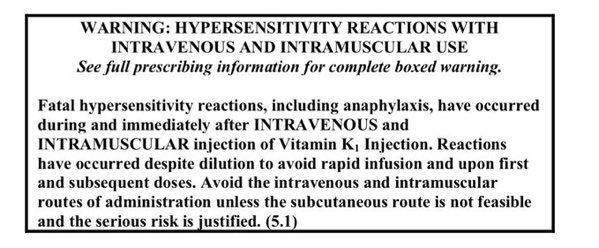
Sure, children born prior to 1915 had a 30 percent chance of dying before their first birthday. Sure, not one person said that all babies prior to 1961 bled to death due to lack of vitamin K, or that this was especially common. Sure, you could point to many diseases and birth defects and point out that no, people are not born with everything they need to survive. Sure, the placenta has absolutely no function once a baby is born. Sure, it’s not good to administer any medication the wrong way. Sure, there has not been a single death related to vitamin K shots since they were first universally administered in 1961, there’s only been one serious case of non-fatal anaphylaxis on record since that time, and the chances of having even a mild allergic reaction is 4 in 21 million.
But have you considered that, um, doctors are bad and probably just want to do this in order to rake in the sweet, sweet profits from shots that are usually provided free of cost to newborn babies? Or to kill them with something that has literally never been known to have killed anyone?
Want to donate to us but not to Substack? Click here or join our Patreon!
I genuinely do not know what we do about this. I just don’t. I mean, I’d like to think it could be somewhat mitigated by a single payer universal health care system that is focused more on people than on profits, but it also seems like these people just think medical professionals are straight up out to get them with no motivation beyond just doing evil for evil’s sake.
The fact that people are willing to let their kids bleed to death rather than see them get a perfectly safe shot, just to own the libs, is beyond disturbing. Personally, I’d say that’s a lot more “evil” than wanting newborns to get a shot so they don’t die from bleeding to death, but your mileage may vary.
PREVIOUSLY ON WONKETTE!


![[community profile]](https://www.dreamwidth.org/img/silk/identity/community.png)